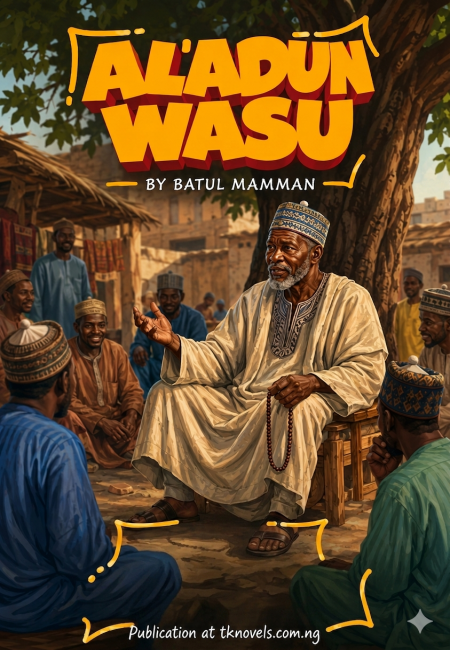
This excerpt from “AL’ADUN WASU” by Batul Mamman (Mrs) presents a deeply layered narrative that blends everyday life with moral reflection, focusing on family values, cultural identity, and the struggles of modern influence within a traditional Northern Nigerian setting.
The story revolves around Mal Bashir, a hardworking carpenter and devoted father, whose life is shaped by resilience after losing part of his hand in an accident. Despite his hardship, he remains committed to guiding the younger generation, often correcting their behavior and warning them about the dangers of drug abuse and poor life choices. His daughter, Zuhra, represents a contrasting struggle she faces academic difficulties, low self-confidence, and uncertainty about her future, yet she possesses a kind heart and deep love for her parents. Their relationship highlights the tension between parental expectations and a child’s limitations.
Alongside this, the narrative explores friendships and societal pressures through characters like Hajara, who is influenced by modern beauty trends such as bleaching and artificial enhancements, sparking moral and religious debates. The story further expands into a broader family network, contrasting traditional values with Westernized lifestyles, particularly in the subplot involving Hamza and his family, where cultural erosion and identity conflict become evident.
Themes of sacrifice, morality, religion, love, and cultural preservation are strongly emphasized. The emotional depth is heightened by moments of humor, discipline, and quiet acts of care within the family.
HAUSA DESCRIPTION
Wannan ɓangare daga “AL’ADUN WASU” na Batul Mamman (Mrs) yana gabatar da labari mai zurfi da sassa daban-daban, wanda ya haɗa rayuwar yau da kullum da tunani na ɗabi’a, yana mai da hankali kan darajar iyali, asalin al’adu, da kuma ƙalubalen tasirin zamani a cikin al’ummar Arewa ta Najeriya mai riƙon gargajiya.
Labarin ya ta’allaka ne a kan Mal Bashir, wani ƙwararren kafinta mai ƙwazo kuma uba mai kishin ‘ya’yansa, wanda rayuwarsa ta sauya bayan ya rasa wani ɓangare na hannunsa sakamakon haɗari. Duk da wannan ƙalubale, bai daina ƙoƙarin tarbiyyantar da matasa ba, yana gyara halayensu tare da gargadin su kan illar shaye-shaye da kuma munanan zaɓin rayuwa. ‘Yarsa Zuhra kuwa tana wakiltar wani irin gwagwarmaya dabam tana fama da matsalolin karatu, ƙarancin yarda da kanta, da rashin tabbas game da makomarta, amma tana da zuciya mai kyau da ƙauna mai zurfi ga iyayenta. Dangantakarsu tana nuna rikicin dake tsakanin fatawar iyaye da kuma iyakar ƙarfin yaro.
A gefe guda kuma, labarin yana duba abota da matsin lambar al’umma ta hanyar halayen mutane kamar Hajara, wacce tasirin salon kwalliyar zamani kamar bleaching da ƙarin gashi ya rinjaye ta, abin da ke haifar da muhawara ta ɗabi’a da addini. Labarin ya kuma faɗaɗa zuwa babban tsarin iyali, inda ake kwatanta dabi’un gargajiya da rayuwar da ta rinjayi salon Turawa, musamman a ɓangaren da ya shafi Hamza da iyalinsa, inda lalacewar al’adu da rikicin asali suka fito fili.
An jaddada jigogi kamar sadaukarwa, ɗabi’a, addini, soyayya, da kare al’adu. Zurfin motsin rai a cikin labarin ya ƙaru ta hanyar lokutan barkwanci, tarbiyya, da kuma ƙananan ayyukan kulawa da juna a cikin iyali.



![<? $row['name']; ?>](https://booktoknovels.com/Public/thumb/225x325/ebook/2026/01/thumb-920512585989.webp)
![<? $row['name']; ?>](https://booktoknovels.com/Public/thumb/225x325/ebook/2026/01/thumb-523353161230.webp)
![<? $row['name']; ?>](https://booktoknovels.com/Public/thumb/225x325/ebook/2026/01/thumb-108728368255.webp)
![<? $row['name']; ?>](https://booktoknovels.com/Public/thumb/225x325/ebook/2026/01/thumb-949891906361.webp)
![<? $row['name']; ?>](https://booktoknovels.com/Public/thumb/225x325/ebook/2026/01/thumb-596280087818.webp)
![<? $row['name']; ?>](https://booktoknovels.com/Public/thumb/225x325/ebook/2026/01/thumb-173293332745.webp)
![<? $row['name']; ?>](https://booktoknovels.com/Public/thumb/225x325/ebook/2026/01/thumb-880926466422.webp)
![<? $row['name']; ?>](https://booktoknovels.com/Public/thumb/225x325/ebook/2026/01/thumb-893168548926.webp)
![<? $row['name']; ?>](https://booktoknovels.com/Public/thumb/225x325/ebook/2026/01/thumb-936868186146.webp)
![<? $row['name']; ?>](https://booktoknovels.com/Public/thumb/225x325/ebook/2026/01/thumb-734427937651.webp)
![<? $row['name']; ?>](https://booktoknovels.com/Public/thumb/225x325/ebook/2026/01/thumb-885497082027.webp)
ENGLISH DESCRIPTION
This excerpt from “AL’ADUN WASU” by Batul Mamman (Mrs) presents a deeply layered narrative that blends everyday life with moral reflection, focusing on family values, cultural identity, and the struggles of modern influence within a traditional Northern Nigerian setting.
The story revolves around Mal Bashir, a hardworking carpenter and devoted father, whose life is shaped by resilience after losing part of his hand in an accident. Despite his hardship, he remains committed to guiding the younger generation, often correcting their behavior and warning them about the dangers of drug abuse and poor life choices. His daughter, Zuhra, represents a contrasting struggle she faces academic difficulties, low self-confidence, and uncertainty about her future, yet she possesses a kind heart and deep love for her parents. Their relationship highlights the tension between parental expectations and a child’s limitations.
Alongside this, the narrative explores friendships and societal pressures through characters like Hajara, who is influenced by modern beauty trends such as bleaching and artificial enhancements, sparking moral and religious debates. The story further expands into a broader family network, contrasting traditional values with Westernized lifestyles, particularly in the subplot involving Hamza and his family, where cultural erosion and identity conflict become evident.
Themes of sacrifice, morality, religion, love, and cultural preservation are strongly emphasized. The emotional depth is heightened by moments of humor, discipline, and quiet acts of care within the family.
HAUSA DESCRIPTION